
Martial Arts Attendance Cards: Layout, Routine and Limits
Nikolay Kazmin · Founder · 2nd dan in karate and ju-jitsu · Updated October 27, 2026

Martial arts attendance cards work best when each card has one box per class, as many boxes as your grading minimum, and the sensei marks every card at the same moment of each training. Keep money off the card, and keep a copy of each student’s count somewhere other than the card itself. A small club with one sensei can run on cards for years without trouble. They start to strain when a second sensei shares the box, a group trains in two halls, or a parent asks what their child owes and the answer is on a different list.
If you only change three things about your cards:
- Print as many boxes as your grading minimum, so a full card means the student has done the classes.
- Collect the cards as students arrive and mark them all in one go after the bow-in.
- Keep fees on a separate list that stays with the club, even if the card has room for them.
What is a martial arts attendance card for?
A martial arts attendance card is a small printed card with one box for each class a student attends. The sensei dates or stamps a box at every training, so the card shows how many classes the student has done since their last grading. Clubs keep the cards in a box by the mat, or students carry their own.
Search for the term and you’ll also find punch cards, which are prepaid blocks of classes. They look the same but do a different job, and the section on fees below explains why I’d keep the two apart.
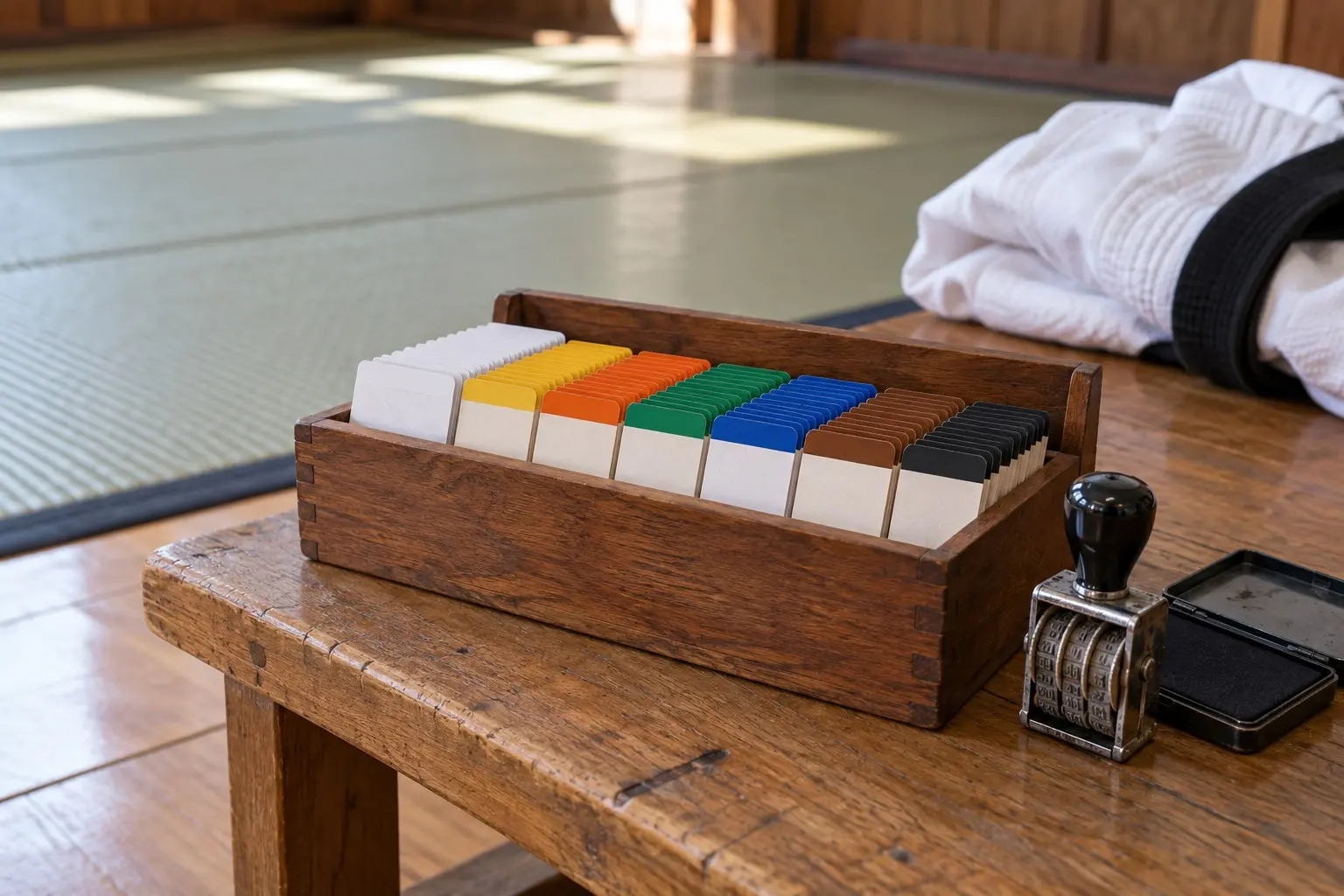
Club-held or student-held cards. The choice decides how your cards fail. A box at the club never gets left at home, but a card nobody pulls from the rack leaves a hole in the record.
| The club keeps the cards | Students keep their cards | |
|---|---|---|
| Where they live | A box or wall rack by the mat | In a training bag or at home |
| Usual failure | A card not pulled, so a training goes unmarked | The card is at home on the day it’s needed |
| Lost card | Rare, unless the whole box goes missing | Common, and the count goes with it |
| Children’s details | Stay with the club | Leave the club with the child |
| Suits | A club with its own hall or a storage cupboard | A club in a rented school gym with nowhere to leave a box |
For children’s groups I’d keep the cards at the club, in a box that travels in the sensei’s bag if the hall has no storage. Adults are better at bringing their own, and some like having the record in hand before a grading.
What to print on a class attendance card
Whichever way you store them, a class attendance card should carry as little as possible. Every extra field is something to fill in at the mat, and on a card that leaves the club it’s something that can be lost with it.
- Club and group: for example “Kids 7-11, Mon and Wed”, so a stray card finds its way back.
- Student name: first name and surname, the same spelling as on your club list.
- Current grade and date of last grading: the date matters because most gradings have a time rule as well as a class count.
- Numbered boxes, one per class: each box takes the date and the initials of the sensei who marked it, or a date stamp plus initials.
- A “carried over” line at the top: used only on a replacement card, for the count brought from a lost or full one.
Leave off phone numbers, dates of birth, fees and medical notes. The GDPR asks that personal data be limited to what is necessary for its purpose, and the purpose of this card is counting classes.
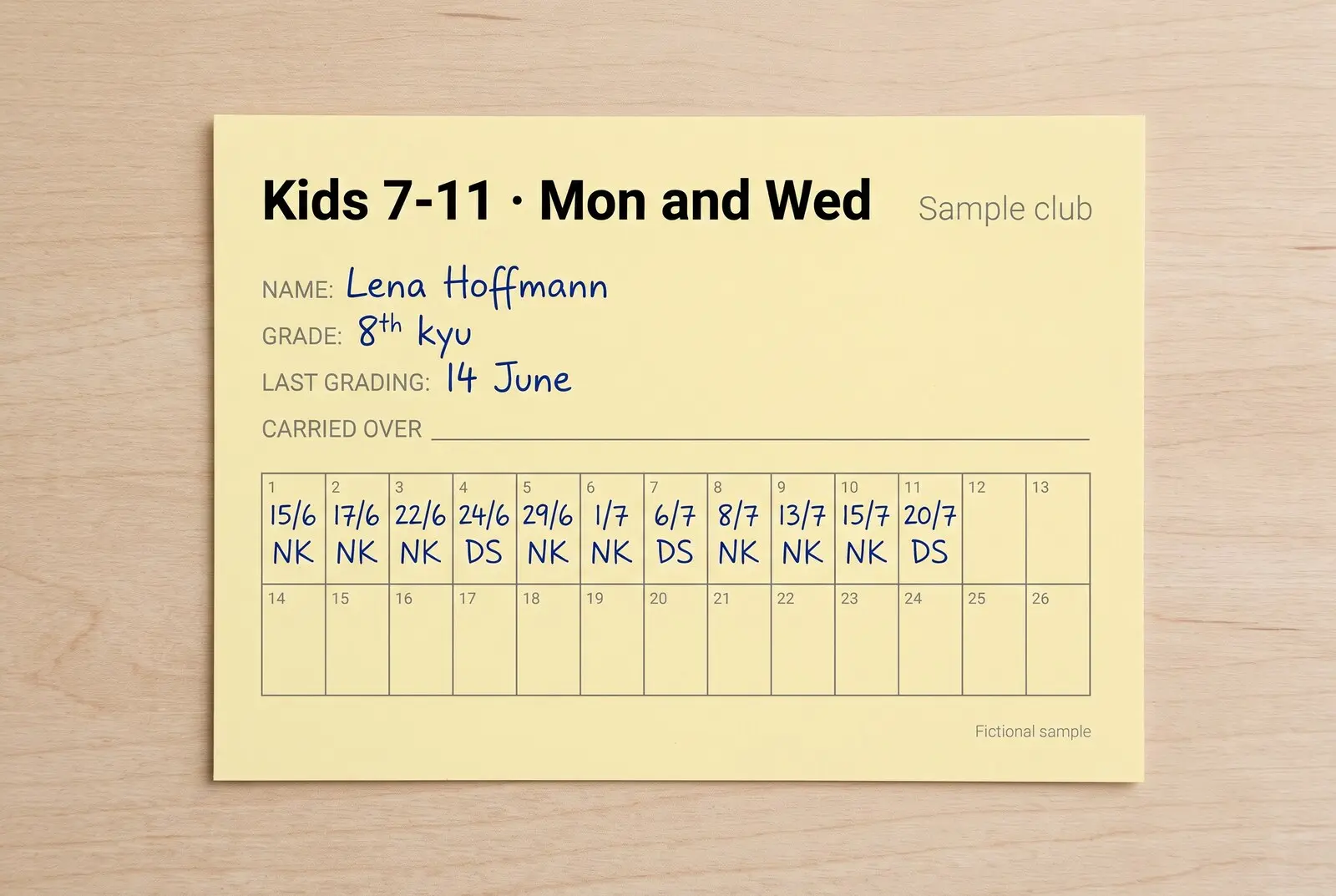
Size the card to your grading rules. Shoto UK, for example, asks students below brown belt for a minimum of 26 lessons since their last grading, so a 26-box card fills exactly when a student becomes eligible on attendance. Check your own federation’s rules before you print a batch. Aikido Australia sets 30 classes and three months at the grade for 5th kyu, which is why the date of the last grading belongs on the card next to the boxes. Higher grades usually need more classes, so a second card or a larger grid for senior students saves rewriting.
A6 card stock (105 x 148 mm) fits four to an A4 sheet and stands up in a rack. Printing each grade on the colour of its belt lets you see at a glance who is close to a grading when you look at the box.
Download the attendance card template (.docx, free)
Using martial arts attendance cards in class
The register habits are the same as for any attendance sheet, and the guide to tracking attendance in a martial arts club covers them: who marks, late arrivals, and two senseis on one group. What follows is only what’s different with cards.
Marking at the bow-in
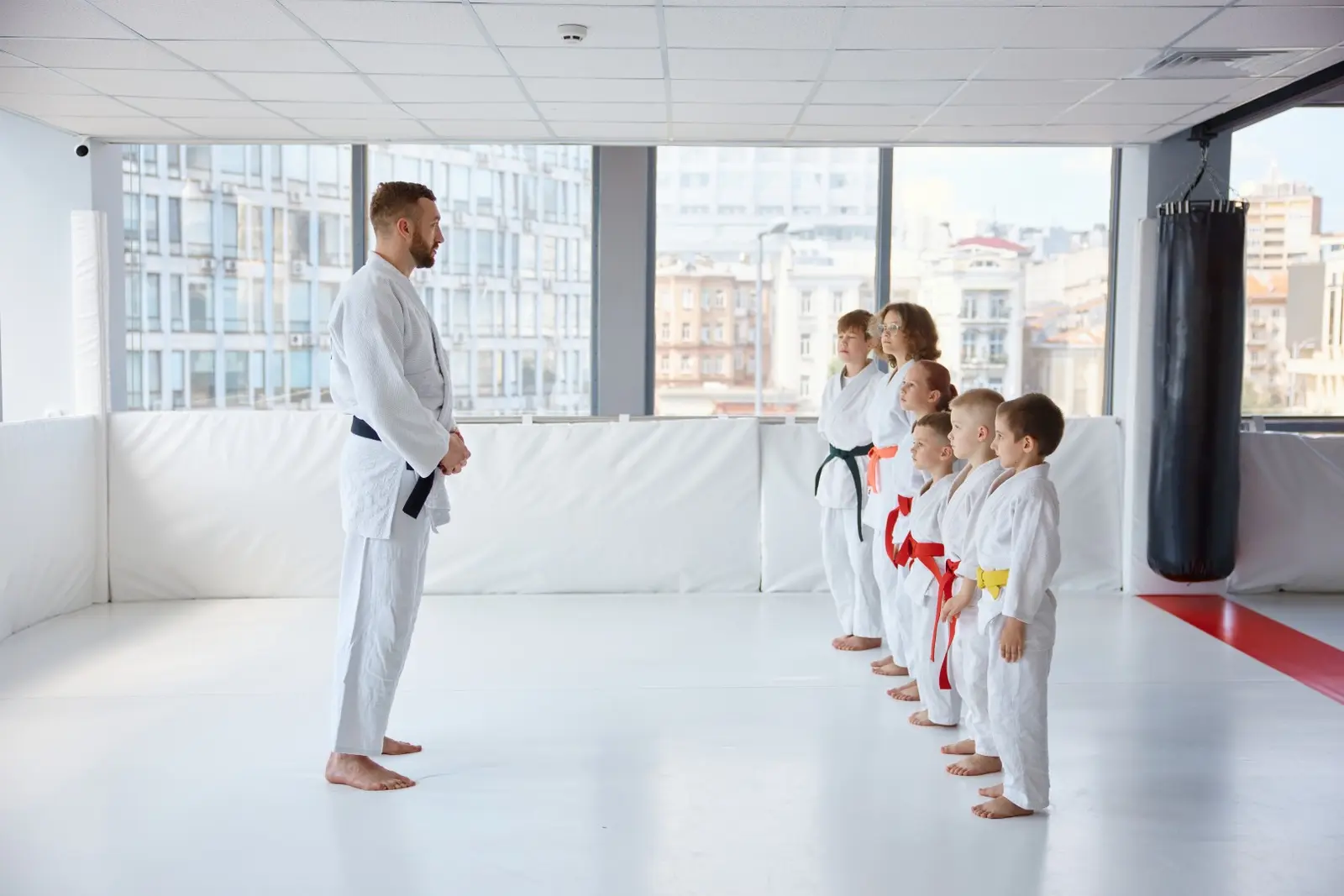
Have students drop their card in a basket as they arrive, then mark the whole pile after the bow-in, when everyone who is coming is on the mat. Marking twenty cards takes a minute or two if a senior student hands them to you in order. Some clubs mark after class instead; that works too, as long as it’s always the same moment. A self-inking date stamp from a stationery shop saves writing the date twenty times, and your initials next to it show which sensei taught.
Before you mark, count the cards against the heads on the mat. A gap is usually a card still in the rack or a late arrival who walked straight on. A student visiting from another group needs no special handling: the card belongs to the student, so the training counts towards their total wherever they train. Write the group’s initial in the box if your club wants to see it.
Forgotten and lost cards
A forgotten card is the most common problem with student-held cards. Keep a few blank slips in the box, write the student’s name and the date, and transfer it to their card at the next training. One club in a 2018 forum thread had students who forgot to sign in do push-ups for the rest of class, and reportedly nobody forgot twice. A slip is gentler.
A lost card is harder, because the count goes with it. This is what to do:
- Issue a new card in the same colour and fill in the “carried over” line.
- Take the count from your backup and initial it, so another sensei can see who set it.
- Without a backup, agree a number with the student or parent and write “estimated” next to it.
The backup is what makes step two possible. At the end of each month, copy each student’s box count into a notebook or a spreadsheet. For a group of twenty it’s about ten minutes, and it turns a lost card from an argument into a reprint. Keep each full card until the student’s next grading in case anyone asks, then hand it back or shred it.
Is a punch card for martial arts classes the same as an attendance card?
No. A punch card is a prepaid block of classes, say ten trainings for €90 within three months, and each punch spends money already paid. An attendance card only records who trained. The two look alike, but a punch card is a money record, with the expiry dates, refunds and disputes that money brings.
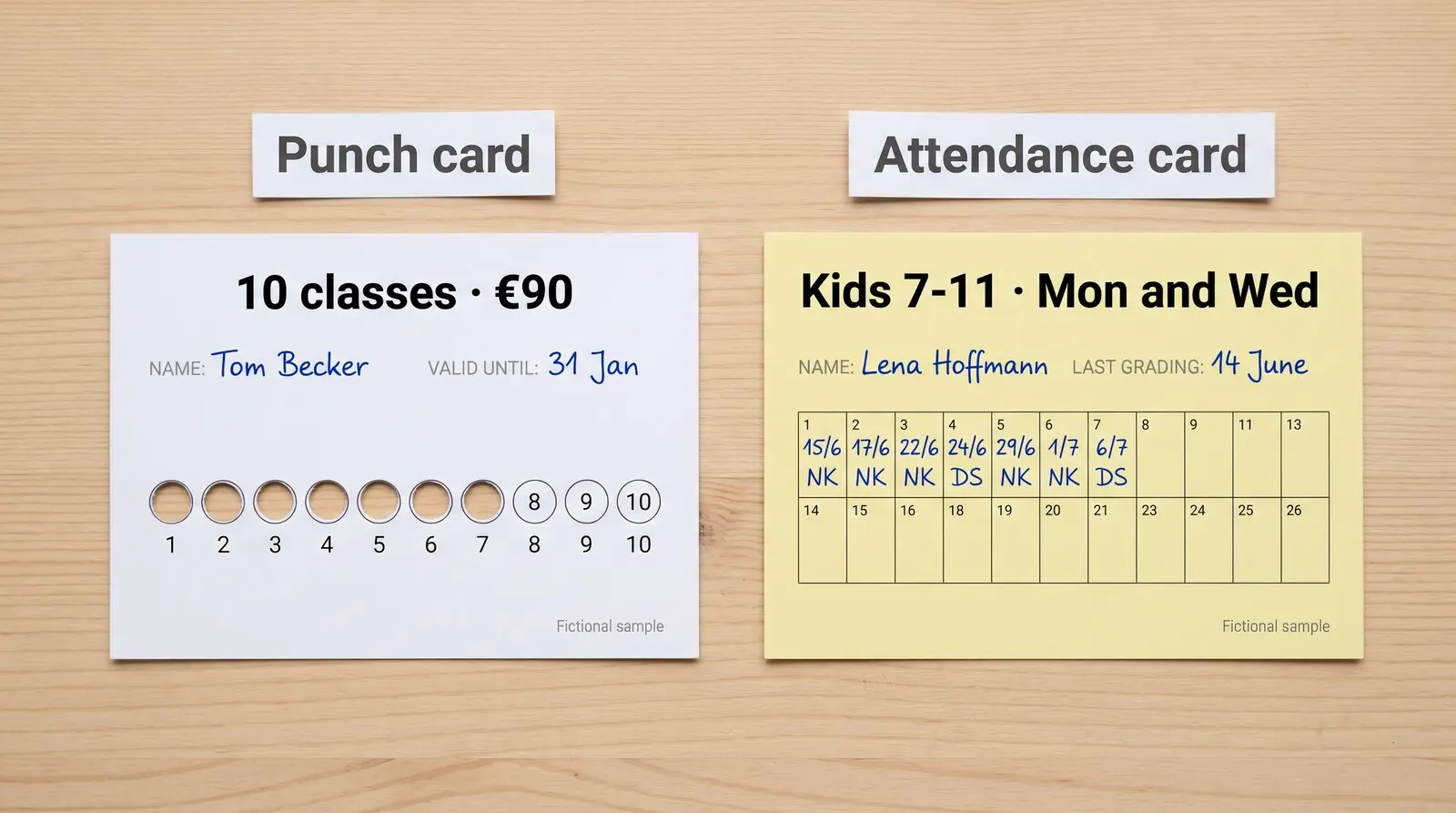
That difference is why a lost punch card hurts more. With an attendance card, a lost card costs a reprint and a carried-over number. With a punch card, it’s three paid classes the student says they had left and the club can’t confirm. A missed punch is a free class, and a child who breaks a wrist halfway through a block raises the question of a refund.
Some clubs that charge monthly fees put both on one card: the sensei initials a box for each class and a separate strip gets a stamp when the month is paid. It works while the card stays at the club. Once it goes home, so does your only record of who has paid. I’d keep fees off the card entirely, on a list that stays with the club: student, month, amount and who took the money. The free attendance and fee spreadsheet has a fees tab laid out that way.
If your club sells blocks of classes, a punch card or a system built for class packs is the right tool for that part. Dojoto records monthly fees, and it doesn’t count down blocks of sessions.
Download the punch card template (.docx, free)
Where martial arts attendance cards stop working
Vendor guides point out that sixty students means sixty cards every night, a real limit for a commercial school that most volunteer clubs never reach. In a small club, cards usually break for other reasons.
A second sensei. The box lives in one sensei’s bag. When someone else covers Thursday, the cards either travel between two people or that training goes on a scrap of paper to be copied later. Initials in each box show who marked it, but the box can’t be in two halls at once.
A second location. A club that trains in a school gym on Mondays and a community hall on Thursdays needs the box in both places, or two boxes and students whose cards are always in the other one.
Counting a season. Your association or the hall’s owner may ask how many children trained this term. That means adding up boxes across forty cards by hand, plus the full cards already filed away.
Parents asking. “How many classes has she done since the June grading?” is answerable only if the card is at the club that evening. “Do we owe for October?” is on another list altogether, often at home.
None of these is about paper as such. They come from one record that several people need at once. It’s the problem I hit when I started leading trainings: the senseis around me used notebooks or Google Sheets, and neither was quick on the mat or easy to share.
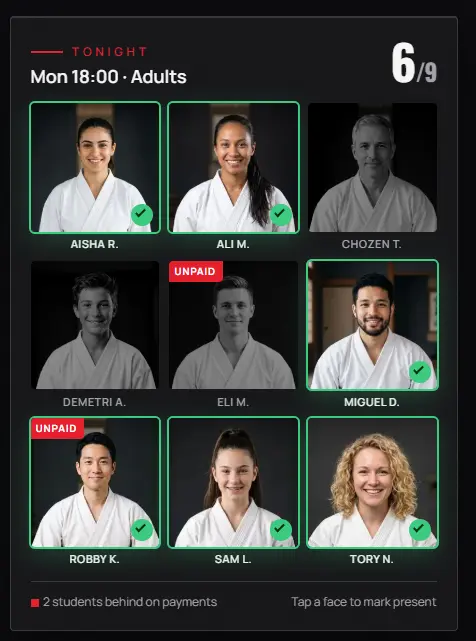
This is where an app helps most: in Dojoto each sensei signs in on their own phone, and when one taps a student present, the other senseis’ screens update on their own. A student behind on fees carries an unpaid badge, so the sensei can answer a parent at the mat. Parents themselves install nothing and have no login.
Moving on from cards without losing the habit
What cards do well is worth keeping whatever comes next: one mark per student per training, made at the same moment every time. A spreadsheet or an app only helps if it keeps that rhythm.
| Cards | Spreadsheet | App | |
|---|---|---|---|
| One mark per class | A stamp or initials | An x in a cell | A tap on a face |
| Counting for a grading | Count the boxes | A formula | Depends on the app |
| Several senseis | One box, one bag | A shared file | Shared, often live |
| Works with no signal | Yes | On paper, typed in later | Usually not |
| Student holds a record | Yes | No | Depends on the app |
The spreadsheet step. Take the box home once and type each student’s current count into a “carried over” column, then mark each training in a monthly tab. Totals for a grading or a season become a formula, and the file can be shared with every sensei. The catch is that marking a spreadsheet on a phone at the mat is fiddly, so many senseis end up writing on paper and typing it in at home.

The app step. Dojoto keeps the one-mark rhythm as a tap on each face, and the trainings for each group appear by themselves. You can start it from a photo of a handwritten list of names or from your spreadsheet. With the belt tracking add-on, each grading goes on the student’s page with its date, so the classes since the last grading come straight from the attendance you already mark. It doesn’t print cards or check a student against your grading rules. If you want the requirements built into each rank, a full management system does that; Gymdesk, for example, lets rank requirements include sessions attended (as of October 2026). Dojoto needs an internet connection, like most apps, and in a basement hall with no signal a box of cards is still the better tool. You can see how the tap-and-pay routine works before deciding.
Cards that run well don’t need replacing, and plenty of clubs keep them for good. When yours start to strain, change where the mark is recorded and keep the moment you make it. If you’d like to keep the one-tap habit and drop the box of cards, join the Dojoto waiting list.
FAQ
Do attendance cards work for adult classes?
They work, but they matter less. With children, the dates on a card show quickly who has stopped coming, so you can speak to a parent early. Adults tend to keep their own count, miss classes for work and come back on their own. Many clubs keep cards for children’s groups and a simple register for adults.
Can two instructors share one set of attendance cards?
Yes, if the box is always where the training is and each sensei initials the boxes they mark. Agree who carries the box home and who covers each day. The arrangement breaks down when both teach in different halls on the same evening, because one set of cards can’t be in two places.
How long should a club keep old attendance cards?
Long enough to settle any question about a grading, which for most clubs means until the student’s next grading. After that the count lives on the new card or in your monthly backup. Hand the old card to the student or shred it, rather than keeping boxes of children’s names for years.
Are attendance cards still worth using?
For a small club with one sensei and one hall, yes. Cards are cheap, need no signal or battery, and give students something to hold before a grading. They become hard work when several senseis share groups, the club trains in two places, or you need totals for a whole season.
Want it for your dojo?
Join the waiting list. Your first 3 months are free.