
Guide
How to Choose Martial Arts Management Software
Nikolay Kazmin · Updated October 06, 2026
Some clubs are whole organizations, with many members across different cities, a hierarchy of head instructors and branches, and membership fees more complex still. Others are a couple of senseis with a single dojo and 20 students. Martial arts management software that suits the first kind of club is the wrong fit for the second, and the other way round. This guide helps you work out which kind of club you run and choose the software that suits it.
What does your club need from martial arts management software?
Start with how fees are paid. A club that collects by card or SEPA direct debit needs a system that moves money. A club paid in cash or by bank transfer only needs to record who paid. Then count your senseis and decide whether logins for students, gradings, bookings or marketing belong in the software.
💶 How fees are paid. Cash, bank transfer, card or direct debit. For cash, check that a payment takes one step at the door and isn’t a workaround for clubs that skip the vendor’s processor.
📋 Who takes the register. Student self check-in needs a kiosk or tablet by the door. A sensei marking on their own phone needs nothing else, and the attendance routine matters more than the tool.
🥋 How many senseis. Two senseis sharing groups need the same live list, and you’ll want to agree who marks attendance and who takes money.
📱 Student or parent logins. Do parents need to see fees, book classes or message you?
🎖️ Gradings. Should belt eligibility live in the software, or do your federation’s records and your notes cover it?
📣 Bookings and marketing. Capacity limits, trial-class funnels and SMS campaigns. A club that doesn’t advertise rarely uses them.
🔒 Children’s data. With juniors, you’ll ask who sees their records and what happens to them when you leave.
Three options: paper, simple apps and full dojo management software
Those answers point to one of three kinds of tool, and each is the right one for some clubs.
Paper or a spreadsheet. It’s free and works without signal, but it gets harder to run as the club grows. Tiny cells are a pain to edit on a phone before training, every new month or extra session means adding columns by hand, and the notebook goes home with one sensei while spreadsheet copies drift apart. If you stay with it, a ready attendance and fee sheet saves you designing the columns.
Simple attendance-and-fees apps. The sensei marks attendance on a phone and records payments that happen outside the app, in cash or by transfer. Dojoto works this way. Apps like this are cheap, and setup is mostly getting your student list in.
Full martial arts management systems. These handle card or direct-debit billing, a member app or portal and belt tracking, often with bookings, waivers and marketing. They’re priced by active members. As of October 2026, the cheapest paid plans below started at €34 to €40 a month for the European tools and $49 to $99 for the US ones, before add-ons, and Spark’s standard rate is $199.
Martial arts management software reviewed: seven options
Here are seven options. Some compete for the same clubs, while others are built for a different kind of club altogether. Prices are as of October 2026 and change often, so check the linked page.
Kicksite
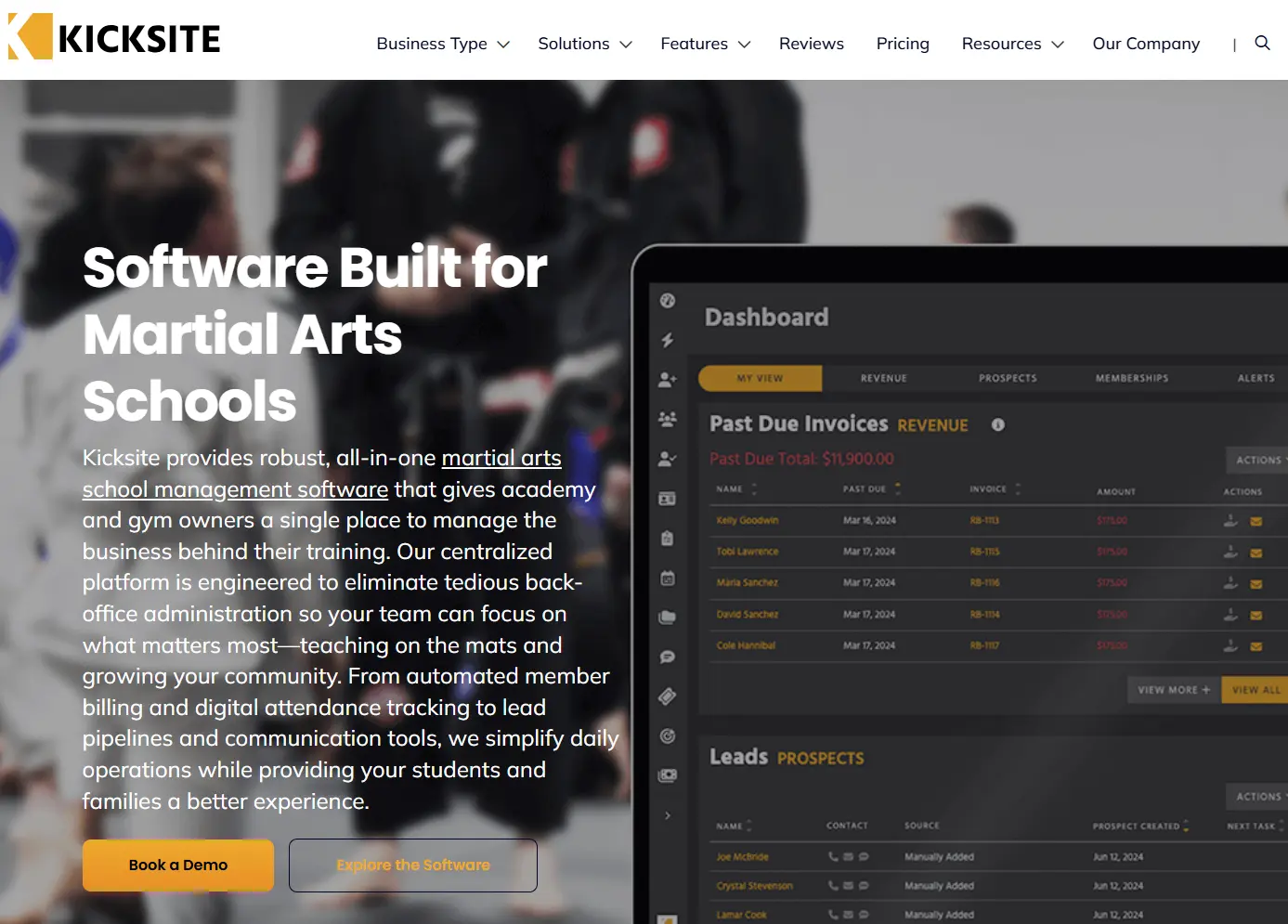
Kicksite is a US all-in-one platform. Students check in at a kiosk with a PIN or barcode. Card and ACH billing is built in through its processing partners, Basys and Stripe, cash taken outside it can be recorded, and belts, a student portal and lead tools come on every tier. As of October 2026, it starts at $49 a month for up to 25 active students, with 30 days free.
Less suited to: clubs that want euro pricing or their own payment provider. Prices are shown in dollars, and payments through a processor Kicksite doesn’t integrate are only recorded in it, not charged from it. Its privacy policy does cover GDPR rights for European customers.
Gymdesk

Gymdesk, formerly Martial Arts on Rails, is gym software with deep martial arts features. Check-in works by kiosk (code, name search, barcode or QR) or on the member’s phone, and there’s a member app and web portal. For Europe it supports Stripe, including SEPA debits, and GoCardless; staff can mark cash or transfers as paid, and rank requirements can count sessions attended. As of October 2026, the Micro plan is $75 a month for up to 50 active members with Gymdesk’s own or an approved partner processor, $100 without, with a 30-day trial.
Less suited to: clubs that want software in their own language or data kept in the EU. Gymdesk names English and Japanese as its native languages and stores personal data primarily in the United States.
Spark Membership
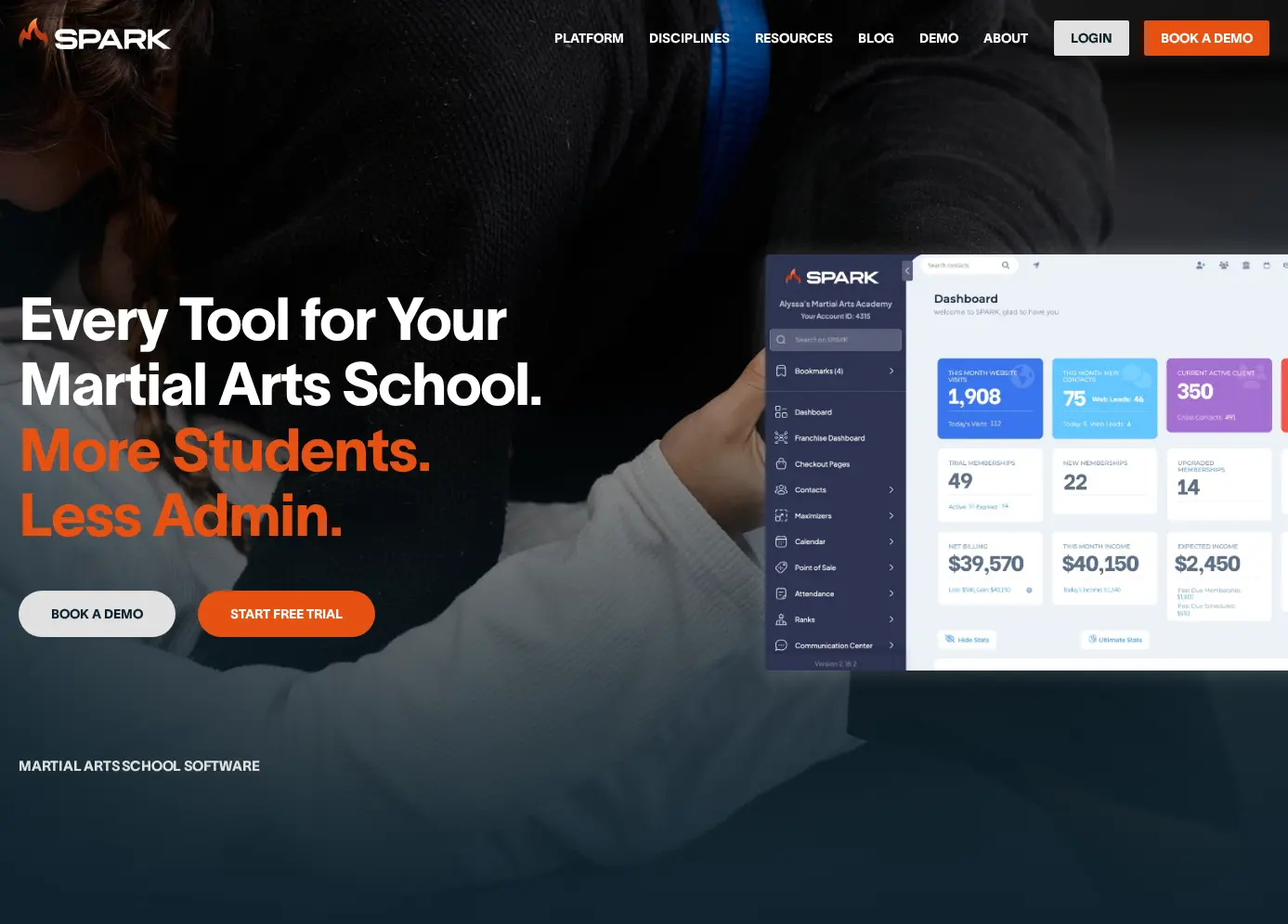
Spark Membership is built for school owners focused on growth. Students check themselves in through a free member app or a kiosk, and the app also covers booking and chat. Belts are tracked per rank, and marketing includes mass SMS and sales funnels. Its standard rate is $199 a month with an 8-week free trial; as of October 2026, the martial arts page offers $99 a month locked for 12 months, also with 8 weeks free. Prices are in US dollars, excluding tax.
Less suited to: clubs that don’t advertise, since much of the price is marketing, and clubs outside the US. Spark processes payments itself, so you can’t bring your own provider, and its terms say the service is provided in US English only.
Kimono

Kimono is a French and English tool “built with senseis, for senseis”. The instructor takes the register on a phone, or members scan a session QR code. It’s hosted in the EU, with a family portal and kyu and dan grades. Cash and cheques can be marked as paid by hand, including partial payments. As of October 2026, the free plan covers one club with up to 50 active members. Pro, at €39 a month or €374 a year for unlimited members, adds Stripe billing, reminders and data export.
Less suited to: clubs that want online payments without paying, since Stripe collection is a Pro feature. The pricing page lists data export under Pro too, so ask what the free plan lets you take with you before you move your records in.
MatGoat

MatGoat is BJJ and dojo software created in 2024. Its website is in four languages and the app in Spanish and English. Students check in at a kiosk on your own tablet, or staff mark attendance from the phone app. Next to Stripe card and SEPA payments, it says plainly that you can record cash or bank transfers on a student’s profile. Belts, teacher permissions and native student apps are included, and data is hosted in the EU, with a data processing agreement on request. As of October 2026, Basic is €40 a month excluding VAT for up to 50 students and Professional €60 for unlimited, with a 30-day trial.
Less suited to: clubs that want the app in a language other than Spanish or English, and cash-paid clubs that don’t need student apps, kiosk check-in and online payments.
Dojos app
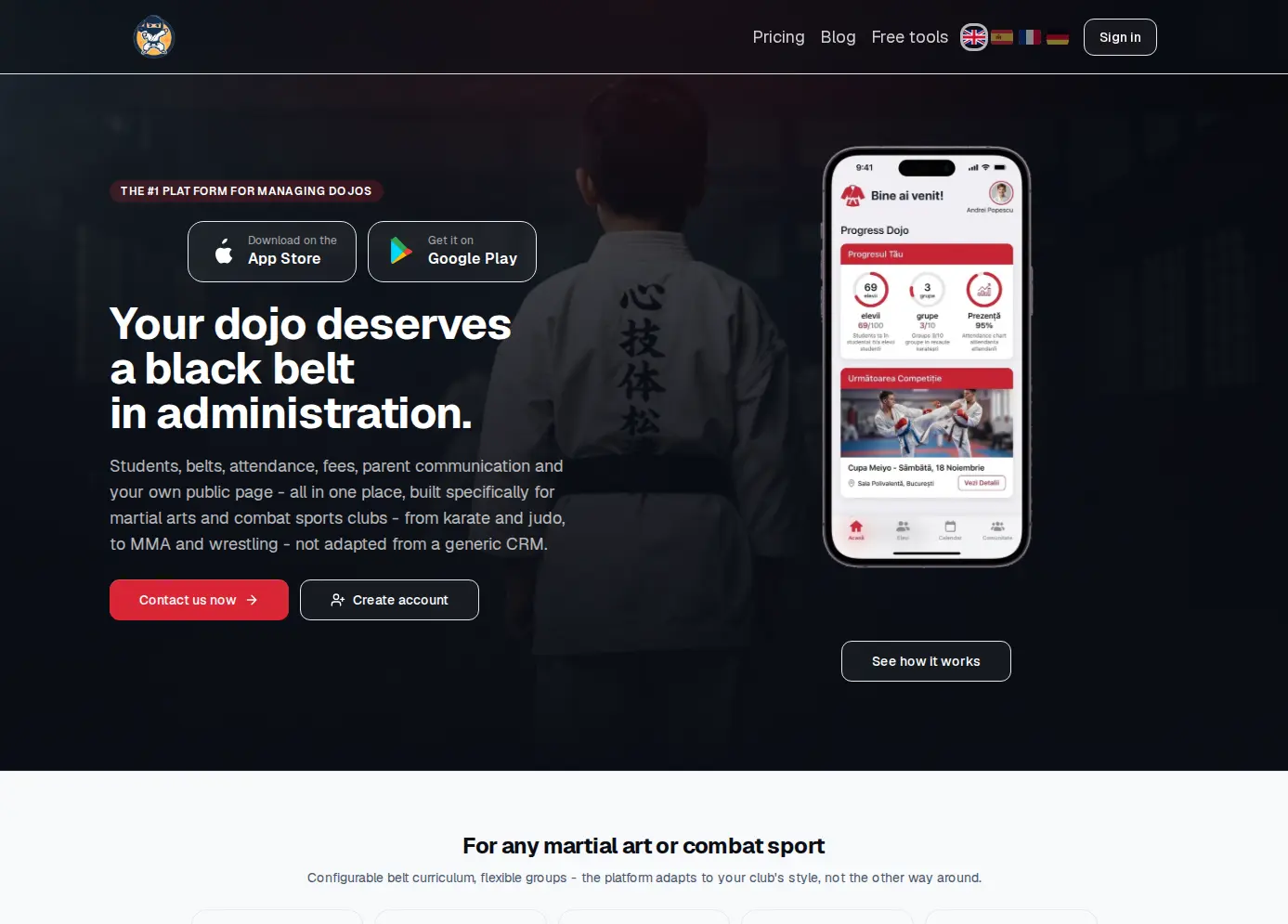
Dojos app says it was built for dojos rather than adapted from a generic CRM. It keeps attendance, belts and fees together, with a fee matrix and sibling discounts, and parents see attendance, belts and fees in their own app. Fees are tracked by hand; it doesn’t process card payments. It states GDPR compliance, with data in the EU or other jurisdictions. As of October 2026, it costs €34 a month for up to 50 students, €44 up to 75 and €52 up to 100, with a 7-day trial and no long-term commitment.
Less suited to: clubs that want students and parents kept out of the software, or that want card payments collected for them.
Dojoto
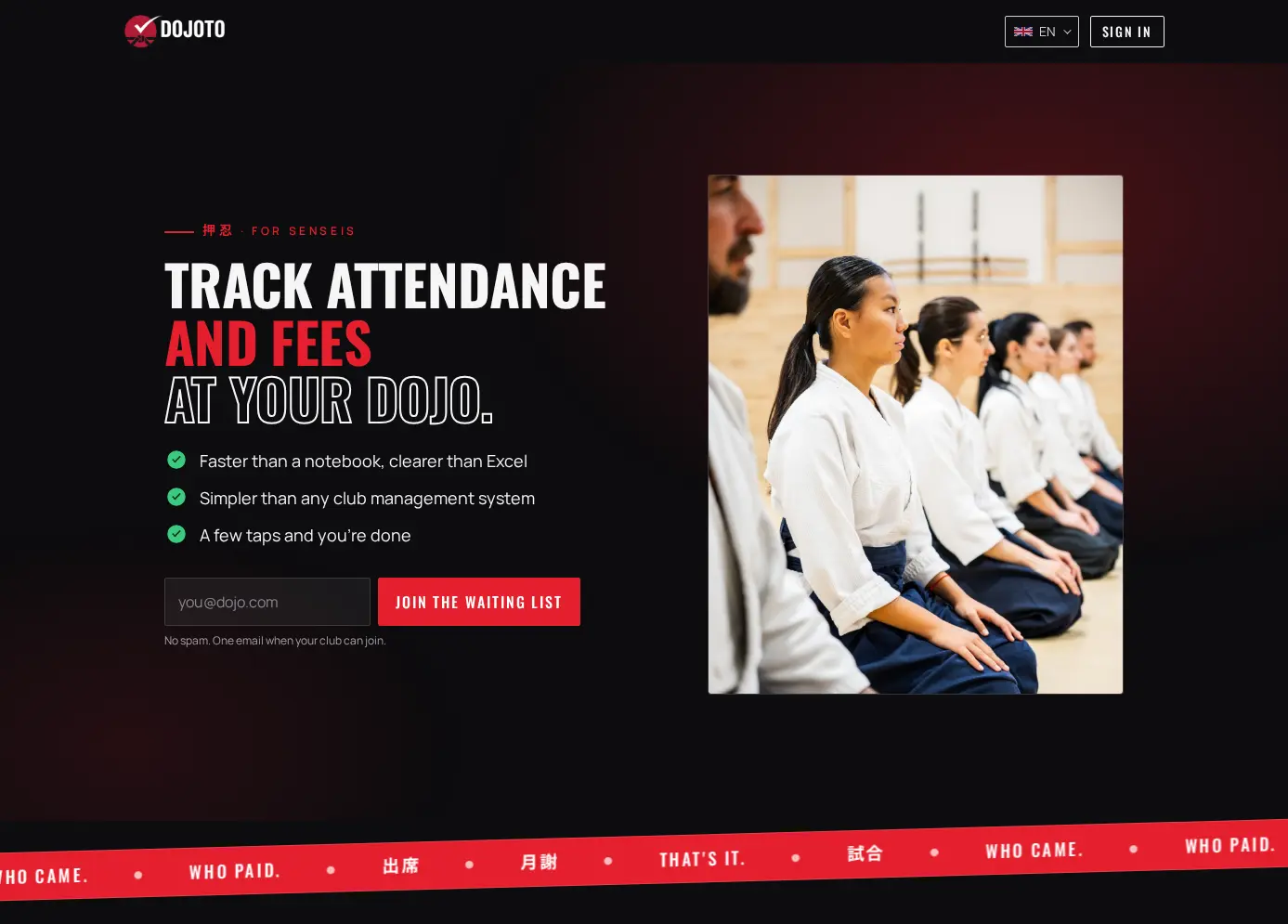
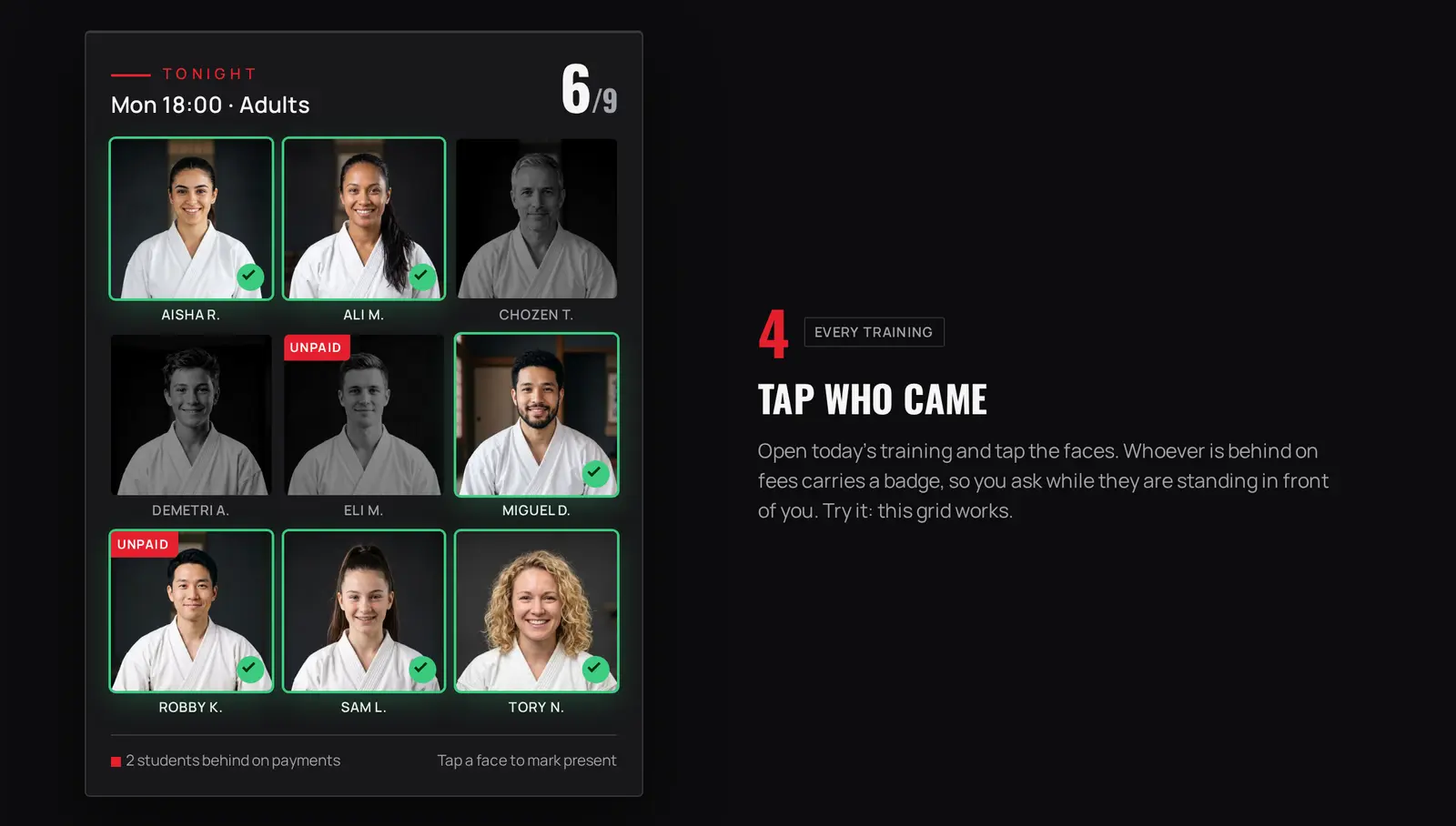
Dojoto started at a karate and ju-jitsu club in Sofia, built by one of its senseis. The senseis there used notebooks or Google Sheets, and the systems on the market were built for much more. It records attendance and monthly fees and nothing else. Only senseis sign in, each on their own phone, and tap the faces of who came; students and parents install nothing. A cash payment or bank transfer is one tap, recorded with the amount and the sensei who took it. Each sensei sees their own groups, the owner sees everything, and the data is hosted in the EU. As of October 2026, the first 3 months are free, then €4 a month for the whole club.
Less suited to: anything beyond the register and fees. It has no card or direct-debit payments, student app, gradings or automatic reminders, and needs an internet connection. It’s also in early access, with clubs invited a few at a time from a waiting list. For very small clubs, free plans cost less: Kimono’s (up to 50 members) or ClubMon’s (up to 30 members, free until at least 31 October 2026).
Martial arts software compared side by side
| Product | Attendance | Card payments | Cash marked as paid | Student or parent portal | Belts and gradings | Languages | Entry price (Oct 2026) |
|---|---|---|---|---|---|---|---|
| Kicksite | Kiosk PIN or barcode, staff mass check-in | Yes | Yes | Yes | Yes | English | $49/mo, up to 25 students |
| Gymdesk | Kiosk, name search, barcode, QR or phone | Yes | Yes | Yes | Yes | English, Japanese | $75/mo, up to 50 members |
| Spark Membership | Self check-in, app or kiosk | Yes | Not stated | Yes | Yes | US English | $99/mo offer (standard $199) |
| Kimono | Instructor’s phone or member QR scan | Pro plan | Yes | Yes | Yes, kyu and dan | French, English | Free up to 50; Pro €39/mo |
| MatGoat | Kiosk self check-in or staff phone app | Yes | Yes | Yes | Yes | Spanish, English | €40/mo + VAT, up to 50 |
| Dojos app | Coach’s phone, per session | No | Yes | Yes | Yes | Not stated | €34/mo, up to 50 |
| Dojoto | Sensei taps faces on phone | No | Yes | No | Optional | English, Spanish, French, German, Italian, Bulgarian | 3 months free, then €4/mo per club |
Finding the best software for your martial arts school, step by step
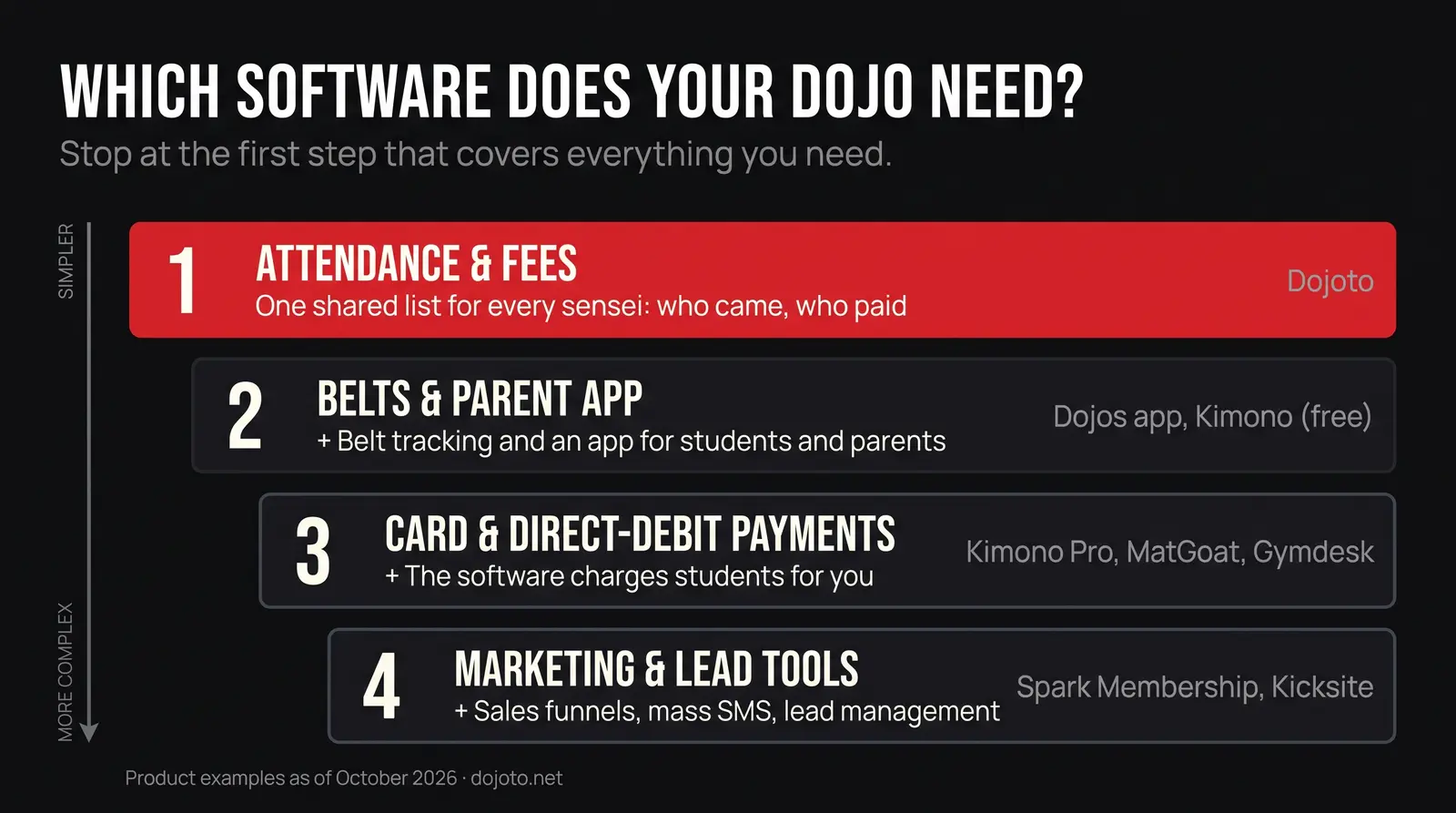
Each step below adds features to the one before it, and the software gets more complex and more expensive as you go down. Stop at the first step that covers everything your club needs.
FAQ
How much does martial arts management software cost?
Most systems charge by active members in steps, so the price jumps at 25, 50 or 100 students. As of October 2026, the cheapest paid plans compared here ran from €34 to $99 a month, with Spark’s standard rate at $199, before processing fees and add-ons. Simpler attendance-and-fees apps cost less, and some are free for very small clubs.
Is there free martial arts management software?
Yes, with limits. Some tools offer free plans capped by member count, typically 30 to 50 active members, usually without online payments. A shared spreadsheet is also free and works well for one sensei with a small group. Check what the free plan leaves out, especially data export, before you move all your records in.
Can martial arts software track cash payments?
Some can, but check how. In several full systems, recording cash is a manual step beside card billing, and some cost more if you use your own processor. Tools built for clubs paid in cash or by transfer record each payment in one step, with the amount and who took it. Test it with a real payment in the trial.
Can I use gym software like Mindbody for a karate club?
You can, and some clubs do. General gym and wellness platforms handle classes, payments and check-in well, and several include belt or progress tracking. They’re built for commercial studios with a front desk, though, so a small volunteer club often pays for scheduling, sales and marketing features it won’t use.
Do I need dojo management software for 30 students?
Not necessarily. Many instructors run 30 students on a paper register or a spreadsheet without trouble. Software starts to pay off when several senseis share groups, when more than one person takes cash, or when you want card payments or a parent app. Below about 20 regular students, a spreadsheet is usually enough, although not very convenient to edit on a little phone screen.
Want it for your dojo?
Join the waiting list. Your first 3 months are free.